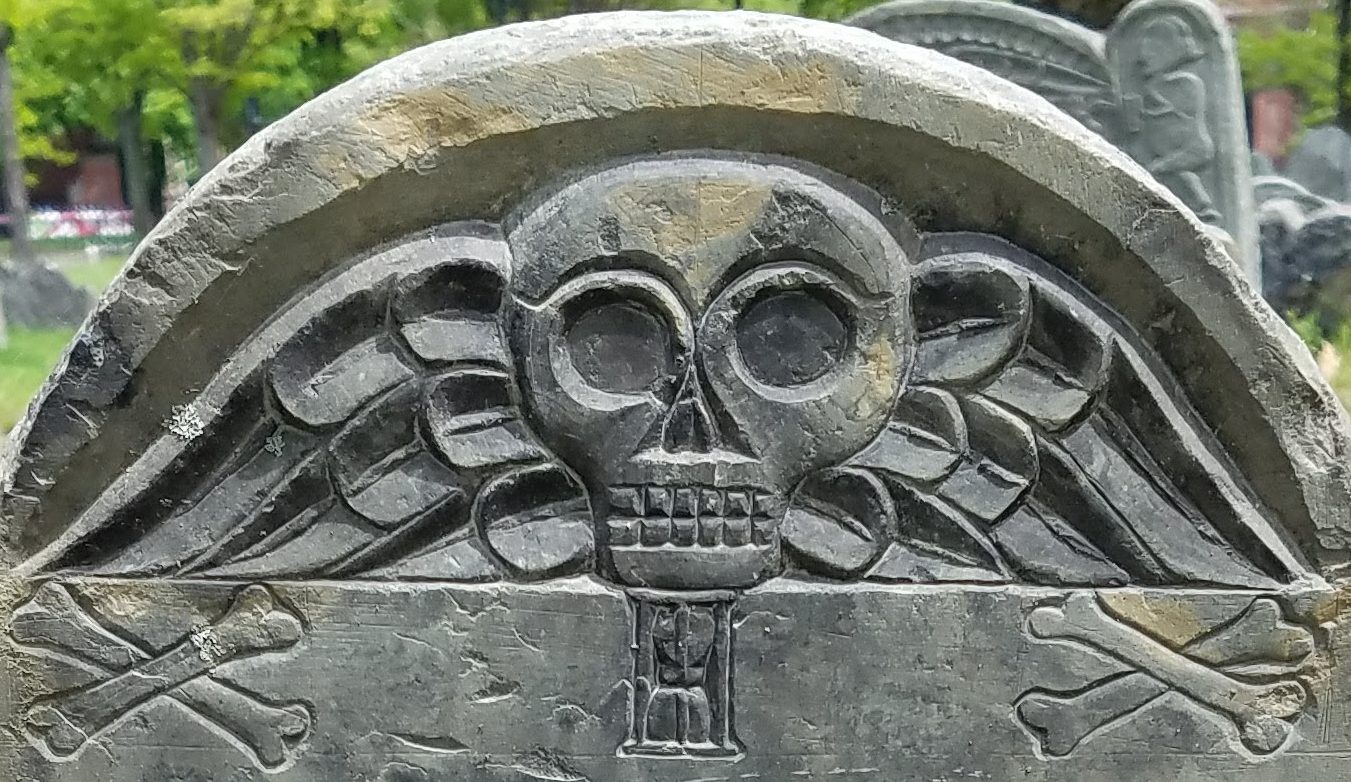

Cemetery, graveyard, churchyard, boneyard, potter’s field, burial ground, final resting place, necropolis, marble town. There are so many different terms for the places where we bury our dead that the differences between them become blurred. Google Book’s NGram Viewer allows us to see how often some common terms for burial places have been published in print in the past four centuries.

For the past 150 years, cemetery has been the most commonly used term for a burial place. However, not all burial places are created equal and these terms are not interchangeable.
Burial places can be organized and separated by examining the five P’s: Place/Proportions, Purpose, Philosophy, Proprietor, and Parts/Pieces. For your convenience, here is a handy table. Feel free to print it and bring it along to your next ramble among the tombstones. I guarantee you’ll be the life of the lichyard!
| Burial Place | Placement/ Proportions | Purpose | Philosophy | Proprietor | Parts & Pieces |
| Cemetery | Usually large, on the outskirts of but not usually inside of a settlement | Burial of the dead in a ritually appropriate manner | Individual memorialization | A secular organization, usually a municipality or a for-profit company | A boundary wall and gate, individual grave markers with names and dates |
| Churchyard | Usually small, attached to place of worship | Burial of the dead in a ritually appropriate manner | Individual memorialization, internment in sacred ground helps soul in afterlife | a religious organization such as a church congregation | Individual grave markers with names and dates. May be more strict as to style and religious symbols allowed |
| Mass grave | Very small to large, containing more than one but up to hundreds of bodies. Often at the site of a conflict. | Dispose of bodies that pose a threat due to disease or evidence of a crime | Dead bodies must be disposed of quickly and efficiently. | No one | One large pit, trench, or hole dug. All bodies deposited at once. Often not marked with individual names. |
| War cemetery | Small to large, at the site of a conflict or in the hometown of fallen. | Honor role of fallen heroes in collective history. Sightseeing destination. | Fallen honored for their role in conflict | National or international agency, often branch of armed forces | Uniform markers reflect military culture |
| Pantheon | Usually small | Commemorate the fallen heroes of the state | National identity symbolized by the sacrifices of heroes | State or federal government | Plaque, statue or memorial. May or may not contain human remains |
The differences between these places are subtle, but significant. Some places honor the dead that rest there, while others seek to make the dead disappear. Some contain human remains, but others not necessarily. All of these places are important in the mortality landscape of our communities and cultures.
References
Rugg, Julie. “Defining the place of burial: what makes a cemetery a cemetery?.” Mortality 5.3 (2000): 259-275.
https://beyond.life/help-centre/admin-legal/whats-difference-graveyard-cemetery/
https://www.nps.gov/nr/publications/bulletins/nrb41/nrb41_10.htm
https://www.encyclopedia.com/international/encyclopedias-almanacs-transcripts-and-maps/mass-grave
 Playing Marbles for Keeps
Leave a comment