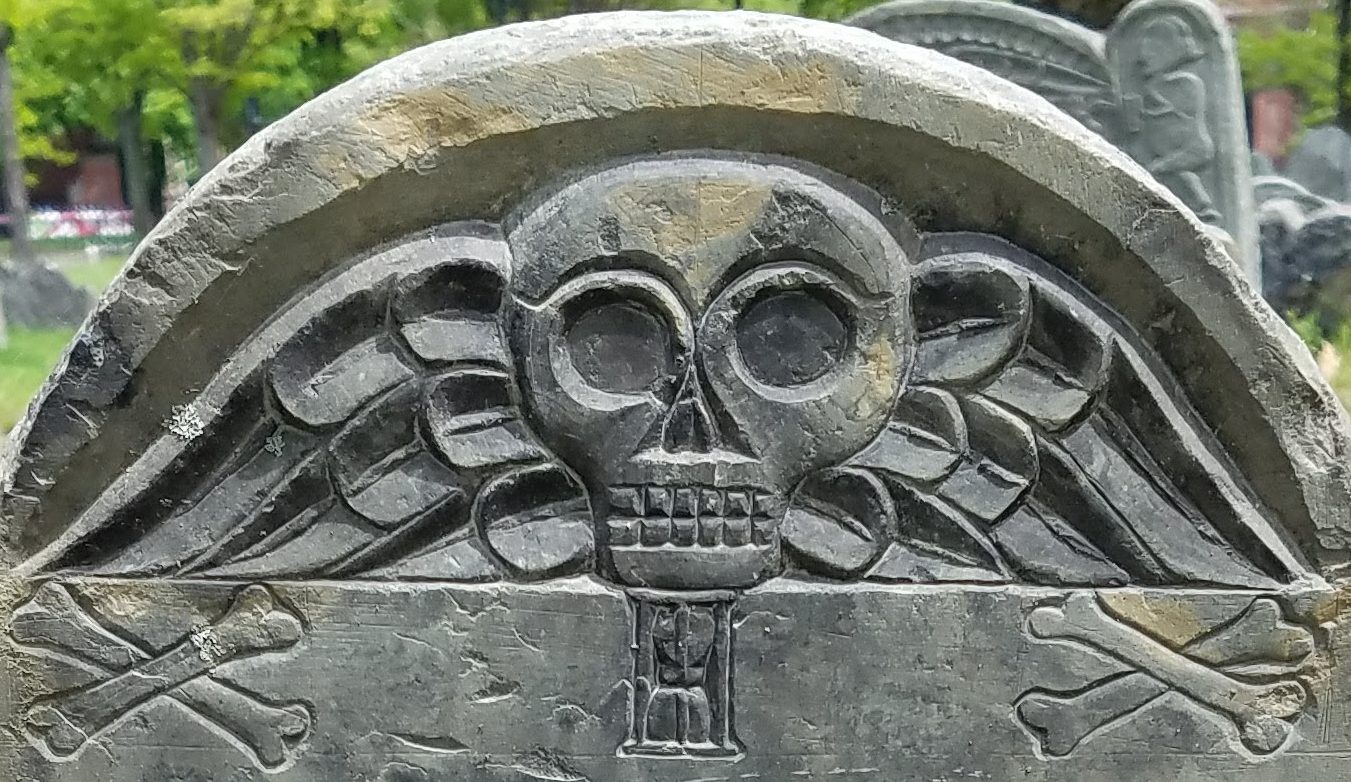

Funeral and burial rituals are often an expression of love by the community. But if the deceased was an outsider or rule breaker, these rituals may be inappropriate. Still, something must be done with the bodies of social outcasts. To solve this dilemma, cultures throughout history and today use subverted or alternative burial rituals to make these undesirable dead disappear. For the most part, these practices can be broken into three strategies: dumping, division, and dismemberment. Who is subjected to these practices can speak volumes about the morals and taboos of the given culture.
DUMPED
One strategy for making the undesired dead disappear is through dumping, which entails disposing of the corpse in a natural or manmade space such as a bog, crevasse, or trash pit. Usually, nothing is done to prepare the body or burial location and the body might be hastily buried or left in the open.
Disposal was the fate of some victims of the Salem Witch Trials of 1692. After they were hanged on Procter’s Ledge on August 19, 1692, the executioners threw the bodies of George Burroughs, John Willard, and Martha Carrier into a rocky crevasse near the hanging site. A contemporary account states that several body parts of the executed were still visible sticking out of the shallow layer of dirt thrown over them. Some legends suggest that family members might have secretly returned at night to bring the bodies home for unmarked burial in family plots. If the intention was to make the ‘witches’ disappear they succeeded; archaeologists have not found any evidence of the bodies on Procter’s Ledge.

Photo courtesy of Flickr user nuclearmse.
Until the 20th century, Catholic doctrine forbade the burial of unbaptized babies, including stillborns, in consecrated ground. Their little bodies, therefore, had to be disposed of in another way. Excavations on the site of a 13th century home in England uncovered the remains of an infant that was buried in the dirt floor near the hearth. Part of the midwife’s duties at the time was to secure burial for such deaths, “in such secret place as neither Hogg nor Dogg, nor any other Beast may come unto it, and in such sort done, as it may not be found or perceived, as much as you may.” Still, sometimes these births were disposed of in other ways, possibly to hide evidence of infanticide, late-term abortion, or pregnancy out of wedlock. Two infant skeletons, one a full-term fetus and the other at 7 months gestation, were uncovered in a late 18th-century privy pit in Philadelphia. Burial in the Quaker churchyard was available for unbaptized and stillborn infants, so researchers suspect that these pregnancies were concealed and the babies disposed of in the privy pit to avoid social stigma or legal persecution for having children out of wedlock.
DIVIDED
Another solution to the problem of the unacceptable corpse is a division of the dead. Their graves are within established burial grounds but might be on the fringes or in their own segregated burial spaces. In many Christian sects, burial in consecrated ground was a privilege denied to those who “died outside the grace of God.” These people included victims of suicide, excommunicates, people with disabilities, outsiders, women who died in childbirth, and unbaptized babies. In Ireland, they created segregated and unconsecrated burial grounds called cillíní. They are usually devoid of any grave markers and lie in isolated places, especially around natural border zones such as shorelines or cliff sides. These spaces symbolize the limbo of Purgatory and protect the living from wandering spirits.
Segregation of burial grounds also happened in the United States for racial reasons. Under Jim Crow laws, cemeteries were segregated by race. During the era of slavery, separate burial grounds allowed slaves to maintain African burial practices. Because these sites were often on the fringes of plantations or settlements, they have been prone to neglect and today preservationists work to rediscover and restore them. A beautiful example of a black burial ground is God’s Little Acre in Newport, Rhode Island. A black enslaved stonecutter named Pompe Stevens carved styled faces on some headstones, showing distinctly African physical features.

DISMEMBERED
In situations in which the dead were the objects of more intense hatred or violence, dismemberment expressed anger or punishment even after death. These bodies are often the victims of war or crimes, and their dismemberment can be part of the cause of death or it can be symbolic. Two skeletons, dating back to the late Roman period, were found in Britain with their legs cut off at the knee and their skulls smashed in. They were buried in hastily dug pits at a site used as a garbage dump. As one of the archaeologists remarked, “Someone really, really didn‘t like these guys.” It is possible they were runaway slaves and their legs were amputated either just before or after their deaths to send a message to the other slaves.

In medieval Europe, beheading was a common method of carrying out capital punishment. Excavated cemeteries have revealed skeletons with bound hands and heads that are missing or else in anatomically impossible positions. One gravedigger favorite seems to be placing the head between the feet of the executed, or cradled in the arm like a baby. Some heads were replaced atop the shoulders but face-down, possibly as an eternal joke.
DIGNITY
In the United States today, those bodies that are dumped, divided, and dismembered tend to be victims of crimes. For the most part, the days of public disrespect of corpses is behind us as something we no longer accept. Even the bodies of executed serial killers and the most fringe members of society are given some measure of dignity and respect.
Our evolution as a society was tested in the wake of the 2013 Boston Marathon Bombing when Tamerlan Tsarnaev, one of the terrorists, was killed while attempting to flee police. For weeks following his death, officials and his family struggled to find a funeral home or mosque that would arrange his funeral and burial. Finally, undertaker Peter Stefan of Graham Putnam & Mahoney Funeral Home agreed to take in the body, which was transported using a series of decoy vehicles and police presence among heavy protests. He was finally able to arrange an unmarked grave in a Muslim cemetery in Virginia for the dead terrorist. At Death Salon Boston, Mr. Stefan spoke about caring for Tamerlan as well as other undesirable dead such as victims of the AIDS epidemic and indigents. He wrapped up his discussion with a call for action for funeral directors to do their part in helping care for controversial figures and the unclaimed dead, saying “Do the right thing…that’s it.”
REFERENCES
Balter, Michael. “‘Deviant’Burials Reveal Death on the Fringe in Ancient Societies.” Science 310.5748 (2005): 613-613.
Brooks, Rebecca Beatrice. “Gallows Hill in Salem, Mass.” History of Massachusetts Blog. 20 October 2012
Brigstock-Barron, Rory. “13th Century Stillborn Found at Huntingdon Dig.” The Hunts Post, 10 April 2013.
Burnston, Sharon Ann. “Babies in the Well.” The Pennsylvania Magazine of History and Biography 106.2 (1982): 151-186.
Dennehy, Emer. “Placeless Dead?: Finding Evidence for Children in the Irish Landscape.” The Journal of the History of Childhood and Youth 9.2 (2016): 213-231.
Kennedy, Maev. “Archaeologists in Cambridgeshire Find Graves of Two Men with Legs Chopped Off.” The Guardian, 18 June 2018.
Knoblock, Glenn A. African American Historic Burial Grounds and Gravesites of New England. McFarland, 2015.
Lee, Anthony. “Outsiders and Executions? An Important New Roman Cemetery near Sleaford.” Roman Lincolnshire Revealed. 18 June 2017
Mattison, Alyxandra. “The Execution and Burial of Criminals in Early Medieval England, c. 850-1150.” University of Sheffield, September 2016.
Stefan, Peter. “The Unwanted Dead: Burying Tamerlan Tsarnaev.” Death Salon Boston, The Order of the Good Death, 29 September 2018, Mount Auburn Cemetery, Cambridge, MA.
Sugg, Richard. “The Hidden History of Deviant Burials.” History Today, 21 February 2017
 Playing Marbles for Keeps
Leave a comment