
Death is one of the few universal problems that all cultures must confront. The way a culture solves the problem of death is deeply rooted in their values about the meaning of life and their beliefs in what will happen after death. When a death occurs in an Islamic community, funeral rituals affirm the dignity and value of the deceased while rejecting ostentatious displays of worldly wealth. Every death unfolds according to an ancient script with deep spiritual meaning.
The QUR’AN AND THE AFTERLIFE
An important verse from the Qur’an in understanding Muslim funeral practices is, “Every soul shall have a taste of death; and only on the Day of Resurrection shall you be paid your full recompense. Only he who is saved far from the Fire and admitted to Paradise, he indeed is successful. The life of this world is only the enjoyment of deception (a deceiving thing).” (Surah Al-Imran, verse 185). While Islam embodies different sects with different beliefs, generally Muslims believe in a Day of Judgement or Resurrection. The dead will wait in their tombs until this day, and then the good will be resurrected and brought to Paradise while the bad will suffer in Hell. Cremation is not permitted, because it would destroy the body before the resurrection. Until recently many Christian faiths, especially Catholicism, also forbade cremation for the same reason.
PREPARING THE BODY
When a Muslim dies, it is important to prepare and bury the body as quickly as possible, preferably within 24 hours. The preparation of the body follows a prescribed set of steps that purifies the body while maintaining the dignity of the deceased. Close family members of the same gender wash the deceased with exceptions for spouses, who can wash a spouse of a different gender, and children, who can be washed by anyone regardless of gender. The body is always washed an odd number of times before being wrapped for burial. A traditional Muslim burial does not use a coffin but instead three white shrouds for a man and five for a woman, which cover the entire body and are knotted at the ends. This practice emphasizes the equality of all persons in death. Prayers for the deceased may take place at a local mosque, and the body is transported in a procession to the cemetery. There is no loud crying or wailing since if the deceased was a good person they are on their way to peace and Resurrection.
THE GRAVE
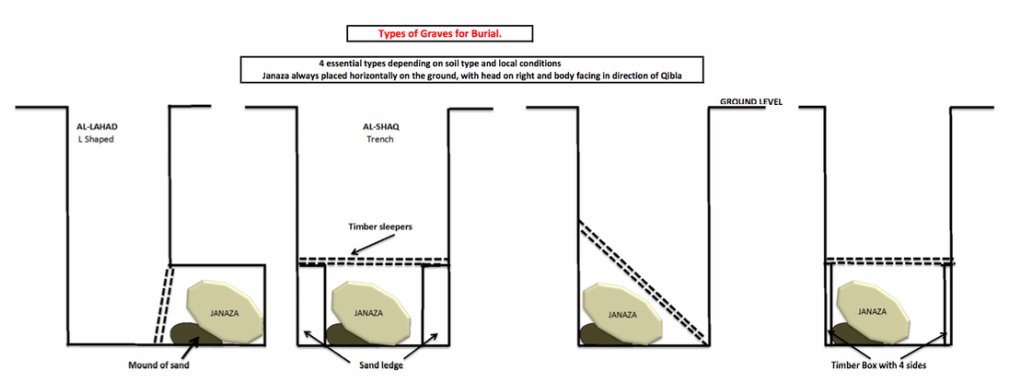
There are two types of graves that are dug in traditional Muslim cemeteries. The first is a simple rectangular grave called a Shiqq. The second, which is preferred, is called a Lahd and is also a rectangular hole but has a hollow carved out of the side of the wall for the body to be tucked into. In either case, no grave liner or vault is used and no grave goods are included. The body is placed in the grave on its side, with the face toward Mecca. A layer of wood or brick is used to build a ‘roof’ over the deceased, and then the grave is filled by each mourner present adding three handfuls of dirt into the grave. When fully closed, the grave will have a low mound over it that indicates its presence, and a small and simple marker might be added. However, in many cases no marker is used at all, further emphasizing the equality of death. No structures such as mausoleums or box tombs may be built on top of graves, and excessive decoration is discouraged.
CEMETERY ETIQUETTE
Visiting graves is highly encouraged in the Islamic faith as an opportunity to reflect and learn. When visiting a Muslim cemetery, it is considered bad manners or unclean to step, sit, or party on top of a grave. Unlike in cultures that celebrate in cemeteries, such as Dia de Los Muertos or All Souls Day, no festivities are ever held in a Muslim cemetery. No flowers, pictures, or excessive decorations can be placed at the grave. This preserves the graveyard as a solemn and peaceful place to reflect without the distractions of worldly goods.
CONTROVERSY AND FLEXIBILITY
Unfortunately, in the United States Muslims have been targeted for discrimination, harassment, and stereotyping. When Muslim communities apply for permits to open much-needed burial grounds, town officials and residents often react with hostility and xenophobia. In rural Texas, the Islamic Association of Collin County filed paperwork to open a cemetery. Residents expressed concerns that the cemetery would be a cover for an Islamic extremist training center, or that uncasketed Muslim burials would be a danger to drinking water. The Islamic Association of Collin County was on the verge of having to file a discrimination lawsuit when the town finally approved their request. As a compromise, the burials in the cemetery will use lightweight plastic grave vaults that can be managed without heavy machinery and a layer of dirt will be spread on the bottom of the vault to comply with the religious need for the body’s contact with the earth.
A similar story of religious discrimination occurred in Worcester, Massachusetts when the Worcester Islamic Center sought to purchase land to create a Muslim section in the local Hope Cemetery. After a year and a half of filed permits, rejected appeals, outraged residents, and national media attention, the first burial in the new section took place in October 2017. Dr. Muhammad Ramzan, president of the Worcester Islamic Center, commented to the media after the burial, “This is how the country flourished when people came and adapted to this country from their homeland. What other proof do you need than wanting to be buried here?”
RESPECT AND ACCEPTANCE
One way that a newly arrived community establishes roots in a new place is through burial. By burying loved ones there, a community declares for itself and others that they plan to stay in this new place and make it their home. Learning about and accepting burial practices for different cultural groups is a way of welcoming them into the greater community. Just as the community that buries a loved one is saying ‘we are not going to leave this place’, making space for them to do so is the greater community saying ‘we want you to be a part of our home.’ That’s why it is so important that we work toward understanding and acceptance so that our communities are more inclusive, whole, and diverse.
Until nex time, maʿ al-salāmah!
REFERENCES
“Rural Texas Town Council Approves Muslim Cemetery Plan.” Associated Press [Dallas], 21 Sept 2018, Web.
Moulton, Cyrus. “After controversy, a Muslim burial at Hope Cemetery in Worcester.” The Telegram [Worchester], 28 Oct 2017, Web.
“Muslim Funeral Traditions.” Everplans, Everplans. n.d. https://www.everplans.com/articles/muslim-funeral-traditions
“The Ghusl Procedure.” Muslim Funeral Services,Muslim Funeral Services Ltd. n.d. https://www.mfs.asn.au/ghusl–burial-steps.html
“Muslim Cemetery.” The Islamic Association of Raleigh. n.d. https://raleighmasjid.org/services/cemetery.html
“Preparation of the Deceased and Janazah Prayers.” Islamicity, Human Assistance & Development International. n.d. http://www.islamicity.com/mosque/Janazah.htm
 Playing Marbles for Keeps
Leave a comment